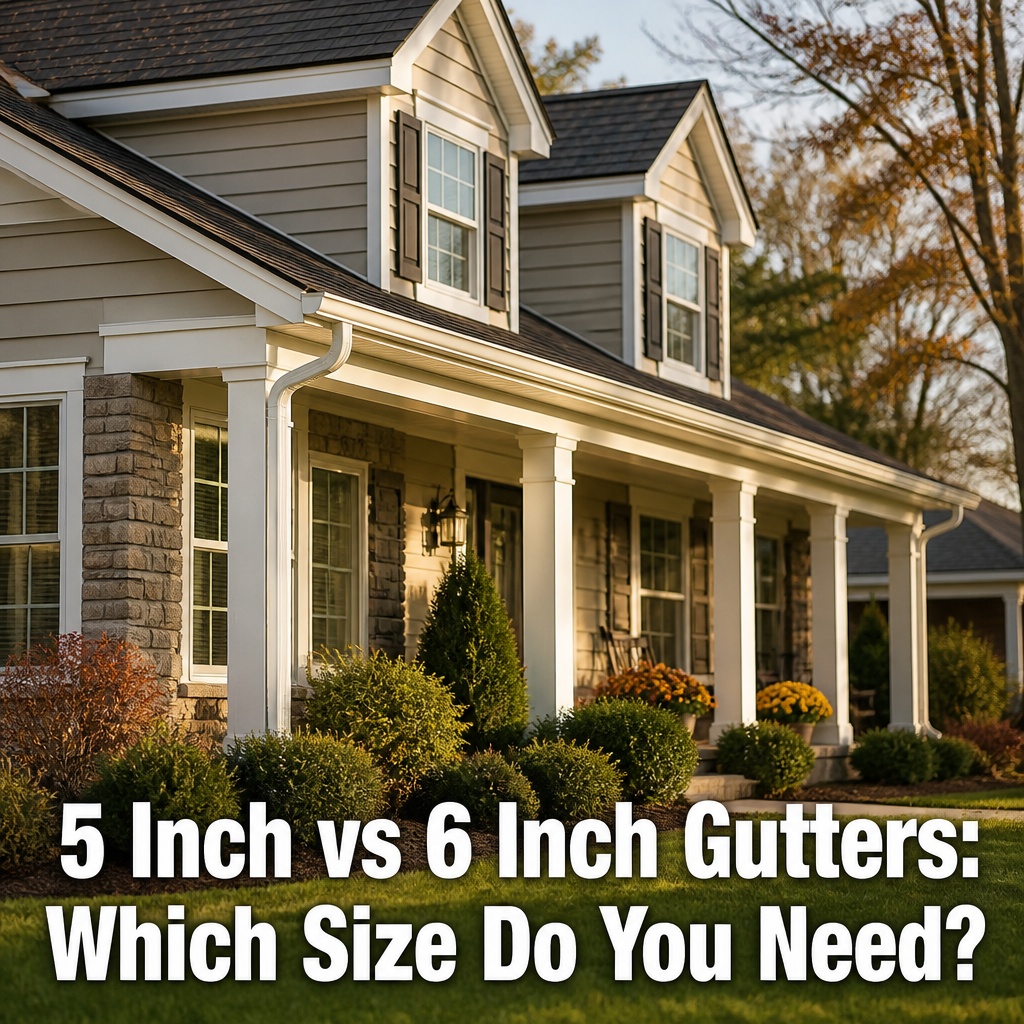
Choosing the right gutter size is one of those decisions that seems minor until your basement floods or your fascia board starts rotting. The difference between 5-inch and 6-inch gutters is not just a matter of aesthetics — it directly affects how well your home handles rainwater, how often you deal with clogging, and how long your roof drainage system actually lasts.
Most homeowners default to whatever the contractor recommends without understanding the reasoning behind the choice. That is a mistake. Gutter size affects water flow, downspout requirements, foundation protection, and even the long-term cost of gutter replacement. Getting it right from the start saves you money and headaches down the road.
This guide breaks down the real differences between 5-inch and 6-inch gutters, covering gutter capacity, installation costs, maintenance demands, and which size fits your specific home. If you are also weighing gutter styles, understanding how K-style and half-round profiles compare can help you make a fully informed decision before committing to any system.
5-Inch vs. 6-Inch Gutters: Key Differences at a Glance
Before getting into the details, here is a side-by-side comparison of the two most common residential gutter sizes. This table covers the core specs that matter most for home improvement decisions.
| Feature | 5-Inch Gutters | 6-Inch Gutters |
|---|---|---|
| Water Capacity | Moderate | High |
| Best For | Small to medium roofs | Large roofs, steep pitches |
| Downspout Size | 2×3 inch or 3×4 inch | 3×4 inch or 4×5 inch |
| Cost Per Linear Foot | Lower | Higher |
| Common Material | Aluminum, vinyl | Aluminum, steel |
| Clog Resistance | Moderate | Better |
| Typical Home Size | Under 2,000 sq ft | Over 2,000 sq ft |
Water Capacity and Flow Rate
Gutter capacity is measured by how much rainwater a gutter can handle per minute without overflowing. A standard 5-inch K-style gutter can handle roughly 1.2 gallons per minute per foot of gutter length. A 6-inch K-style gutter bumps that up to approximately 2 gallons per minute — a significant difference during heavy rainfall events.
The math matters more than most people realize. If your roof has a large surface area or a steep pitch, water rushes off faster and in greater volume. A 5-inch gutter simply cannot keep up with that kind of water flow, which leads to overflow, water damage along the roofline, and eventual foundation problems.
Gutter capacity is not just about the gutter itself — it is about the entire drainage system working together. The size of your downspouts, the number of outlets, and the slope of the gutter all play into how efficiently rainwater exits the system.
Downspout Size and Drainage Efficiency
Downspouts are the unsung heroes of roof drainage. A 5-inch gutter typically pairs with a 2×3-inch or 3×4-inch downspout. A 6-inch gutter usually requires a 3×4-inch or larger 4×5-inch downspout to match its higher water flow capacity.
Mismatching gutter size with downspout size creates a bottleneck. Even if your 6-inch gutters collect rainwater efficiently, undersized downspouts will cause backup and overflow. Proper drainage efficiency depends on the entire system being sized correctly from the start.
More downspouts are sometimes better than larger ones, especially on longer gutter runs. A general rule is one downspout per 30 to 40 linear feet of gutter, though this varies based on rainfall intensity and roof pitch in your area.
Appearance and Fit on Different Rooflines
Aesthetics matter in home improvement, and gutter size does affect curb appeal. On a smaller home with modest rooflines, 6-inch gutters can look oversized and out of proportion. On a large two-story home or a house with wide eaves, 5-inch gutters may look undersized and inadequate.
The fascia board width also plays a role. Most standard fascia boards accommodate both sizes, but older homes with narrower fascia may require some modification before 6-inch gutters can be properly mounted. Always check fascia condition before gutter installation.
K-style gutters are the most common profile in both sizes, offering a flat back that mounts flush against the fascia board. Half-round gutters are also available in both sizes but are more common in 6-inch configurations for larger homes and historic properties.
Pricing, Installation, and Maintenance Comparison
Cost is always part of the conversation, and gutter size directly affects what you pay — both upfront and over time. Understanding the full cost picture helps you make a smarter investment rather than just choosing the cheapest option.
Material and Installation Cost Differences
Aluminum gutters are the most popular material for both 5-inch and 6-inch systems. For 5-inch aluminum gutters, expect to pay between $4 and $9 per linear foot for materials alone. Six-inch aluminum gutters typically run $6 to $12 per linear foot. Vinyl gutters are cheaper but less durable, especially in climates with extreme temperature swings.
Professional installation adds labor costs on top of materials. Seamless gutters, which are custom-cut on-site, cost more than sectional systems but reduce leak points significantly. If you are comparing seamless versus sectional gutter systems, the long-term performance difference is worth understanding before you finalize your budget.
The total cost difference between 5-inch and 6-inch systems on an average home is typically $200 to $600, depending on linear footage and material choice. That gap narrows considerably when you factor in the cost of water damage repairs caused by an undersized system.
Long-Term Maintenance and Clog Resistance
Clogging is the number one maintenance issue for any gutter system. Leaves, twigs, and debris accumulate over time, blocking water flow and causing overflow. Six-inch gutters have a wider channel, which means debris has more room before it creates a full blockage. This does not eliminate clogging, but it does reduce frequency.
Gutter guards are an effective add-on for both sizes. Micro-mesh guards work well on 5-inch systems, while 6-inch gutters can accommodate a wider range of guard styles. Adding gutter guards to either system reduces cleaning frequency from twice a year to once every few years in most climates.
Seamless gutters in either size also reduce maintenance needs because they eliminate the joints where debris tends to collect and leaks tend to form. Regular inspection of downspouts is still necessary regardless of gutter size or guard type.
Value for Money by Roof Size
For homes under 1,500 square feet with a low to moderate roof pitch, 5-inch gutters offer excellent value. They handle typical rainfall without issue, cost less to install, and are easier to source and replace. Gutter replacement on a smaller home with 5-inch gutters is a straightforward, affordable project.
For homes over 2,000 square feet, or any home in a high-rainfall region, 6-inch gutters deliver better long-term value despite the higher upfront cost. The reduced risk of water damage, foundation erosion, and overflow-related repairs more than compensates for the price difference over time.
Square footage alone does not tell the whole story. A 1,800-square-foot home with a steep roof pitch may need 6-inch gutters, while a 2,200-square-foot home with a shallow pitch might do fine with 5-inch gutters. Roof pitch and local rainfall intensity are equally important variables.
Best Use Cases and Unique Selling Points

Neither gutter size is universally better. The right choice depends on your specific home, your local climate, and your long-term maintenance preferences. Here is how to think through the decision clearly.
When 5-Inch Gutters Make Sense
Five-inch gutters are the standard for a reason. They work well for the majority of residential homes in moderate climates and are widely available in aluminum, vinyl, and steel. Their lower cost makes them the practical choice for budget-conscious homeowners who do not have extreme drainage demands.
- Homes with less than 1,500 square feet of roof surface area
- Properties in regions with moderate annual rainfall
- Roofs with a low to moderate pitch (under 6:12)
- Homes where aesthetics favor a slimmer gutter profile
- Gutter replacement projects where existing fascia is sized for 5-inch systems
Five-inch gutters are also easier to find in a wider range of colors and finishes, which matters for homeowners who want their gutters to blend seamlessly with their exterior. Vinyl gutters in 5-inch size are particularly common and affordable for DIY-friendly installations.
When 6-Inch Gutters Are the Better Choice
Six-inch gutters are not overkill — they are the right tool for specific situations. Homes in heavy rainfall zones, properties with large or steep roofs, and houses surrounded by mature trees all benefit from the added capacity and clog resistance that 6-inch systems provide.
- Homes with more than 2,000 square feet of roof surface
- Steep roof pitches of 6:12 or greater
- Regions with frequent heavy rainfall or intense storm seasons
- Properties with significant tree coverage and high debris load
- Homes where foundation protection is a priority due to soil type or grading
Six-inch gutters also pair better with larger downspout configurations, which improves overall drainage efficiency on complex rooflines with multiple valleys and angles. For large homes, this translates directly into fewer overflow events and less water damage risk.
Climate, Roof Pitch, and Home Size Factors
Climate is arguably the most important factor in gutter sizing. A home in a dry region with occasional light rainfall can function perfectly well with 5-inch gutters for decades. The same home relocated to a high-rainfall coastal area would likely experience chronic overflow and water damage with the same system.
Roof pitch amplifies water volume. A steep roof sheds water faster than a shallow one, concentrating more rainwater into the gutters in a shorter time. This is why roof pitch is always part of a professional gutter sizing calculation, not just an afterthought.
Home size affects total roof surface area, which determines the volume of rainwater your gutters must handle. Knowing how to accurately measure your roof before installation is essential — understanding how to measure your home for new gutters ensures you get the right size system from the start and avoid costly mistakes.
Conclusion
The choice between 5-inch and 6-inch gutters comes down to three core factors: your roof size, your local rainfall intensity, and your roof pitch. For most standard homes in moderate climates, 5-inch gutters are entirely sufficient and offer a cost-effective solution. For larger homes, steeper roofs, or high-rainfall environments, 6-inch gutters provide the capacity and durability needed to protect your home long-term.
Do not let price alone drive the decision. An undersized gutter system that overflows during every major storm will cost far more in water damage repairs than the savings from choosing a smaller size. Invest in the right system for your specific conditions, and your gutters will protect your home effectively for years to come.
Material choice matters too. Whether you go with aluminum gutters, vinyl gutters, or steel, the quality of the material and the professionalism of the installation determine how long your system performs. If you are still weighing material options, reviewing how vinyl and aluminum gutters stack up against each other is a smart next step before making your final call.
FAQ
Are 6-inch gutters worth the extra cost?
For the right home, absolutely. If your roof is large, steeply pitched, or located in a high-rainfall area, 6-inch gutters provide significantly better water flow and clog resistance than 5-inch systems. The upfront cost difference is typically modest compared to the potential cost of water damage from an overflowing or undersized gutter system. For smaller homes in moderate climates, the extra cost may not be justified.
Do 5-inch gutters work for most homes?
Yes. Five-inch gutters are the most commonly installed residential gutter size for good reason. They handle the drainage needs of the majority of homes in North America effectively. As long as your roof surface area is not excessively large and your local rainfall is not extreme, 5-inch gutters paired with properly sized downspouts will provide reliable roof drainage and foundation protection for many years.
Can 6-inch gutters reduce clogging and overflow?
Six-inch gutters do reduce the frequency of clogging compared to 5-inch systems because the wider channel gives debris more room before it creates a blockage. They also handle higher volumes of rainwater without overflowing during heavy storms. However, no gutter size eliminates clogging entirely. Adding gutter guards and scheduling regular maintenance are still necessary to keep any system performing at its best, regardless of size.
Leave a Reply